Hello everyone! 👋
This week, we at SSE Web Solutions Company are here to share some valuable knowledge on Data Analytics – more specifically, Data Mining.
🔹 What is Data Mining?
You might be wondering:
What exactly is Data Mining?
How should we understand it?
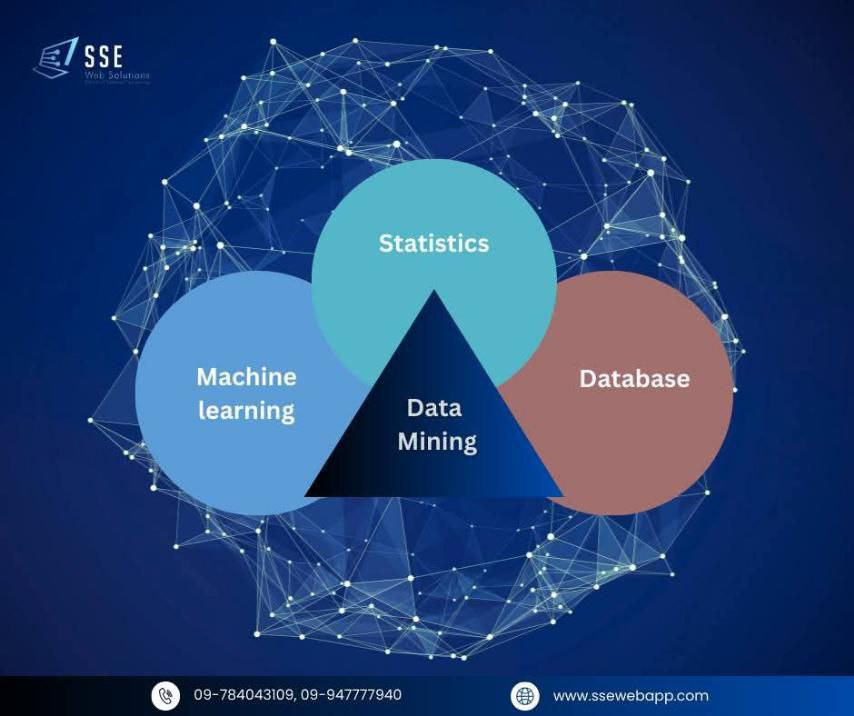
Data Mining is also referred to as KDD – Knowledge Discovery in Databases.
Just like extracting gold, silver, or oil from deep within the earth, data mining is the process of digging through large datasets to find valuable insights.
To make it easier to understand:
Imagine a customer walks into a store and buys milk. Based on common purchasing patterns, they’re also likely to buy bread or butter along with it.
➡️ This ability to predict what related items a customer may want is a perfect example of data mining in action.
📌 Why Is Data Mining Important?
Data Mining is a powerful tool for business growth.
It helps uncover patterns, trends, and insights that can lead to better decision-making and increased profits.
So as a business owner, entrepreneur, or team member, understanding Data Mining is essential to staying competitive in the digital world.
💠 Understanding Data Starts with Knowing What "Data" Is
Before you can truly understand Data Mining, you need to be familiar with data types and structures.
So, what is data?
Data is actually more valuable than gold, silver, or oil in the tech world.
Everything we interact with daily — names, quantities, choices — all of these are data.
💡 In IT, data is the foundation of revenue and innovation.
🔹 Two Main Types of Data
📌 1. Qualitative Data (Descriptive)
This type of data is not numerical. Examples include:
-
Hair color
-
Gender
-
Names
-
Economic status
Qualitative data is further divided into:
-
Nominal Data (categories with no order)
-
Ordinal Data (categories with a specific order)
📌 2. Quantitative Data (Numerical)
This type includes numeric values such as:
-
Temperature of a room
-
Number of students
-
Product prices
Quantitative data includes:
-
Discrete Data (countable values)
-
Continuous Data (measurable, infinite values)
💡 Other Important Data Types Used in Data Mining:
🔹 Time-Series Data
🔹 Cross-Sectional Data
🔹 Structured Data
🔹 Semi-Structured Data
🔹 Unstructured Data
All of these data types play a key role in successful data mining and analytics.
We’ve also included visual examples to help you understand them more clearly.